Discipline Strategies
Toddler Chore Chart Idea
Here is an example of a chore chart we use in our home for our pre-readers. We use clip art instead of words and allow them to put a sticker on the photo when they complete a task. Many little ones as early as 2 can understand a chart like this. Younger ones can still help out but will need one on one direction much more and clip art will only be a fun thing to look at!
Printable Version Toddler Chores

Official Time Out Steps
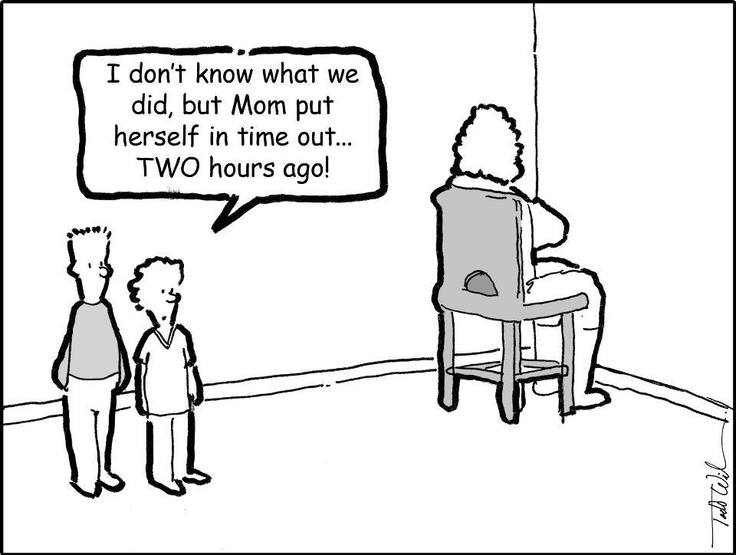 We use time out in our family. I understand why some feel it is controversial but with some prayer and some modifications, we have felt it has been a good decision for our family. Perhaps it may be a good fit for you too! If not, no worries. Just skip to another post!
Why do we use Time Out as a discipline measure?
Well, we are convinced that it is our job to provide as many parallels to the “real world” as possible to prepare our children for their future adult lives. In the “real world,” time out is a discipline tool used all the time! Really. Think about it! You break rules and you get suspended, expelled, fired, probation, and even jail time. Time out happens and I would rather teach them to avoid it whilst they’re young, than be deduced to visiting hours only. Besides, I love them. A ton! If they need to learn something, I prefer it to be from someone who loves them! For example, if you bully in my home (refer to our bullying guidelines), you will go away (time out). I am a big believer that techniques should simulate life. You’re giving them a realistic view of their world. If you bully as an adult you could go to time out…and it will have bars! The point of a time out or a punishment is to bring that person back to the family, to join in a happy unit. It is not about you ridding yourself of some anger. The purpose is to restore and reteach.
How do we use Time Out?
We basically took everything we learned about time out and threw it out the window. We start young! I mean young! Like by 15 months. Obviously that would differ per child since development happens at different rates. We do not use a 1 minute per age rule because we believe correction should only last as long as it needs to for effectiveness and not a millisecond longer. For our littlest ones, we will do a very quick correction. Here is how it works.
Step 1- Change the Location- Quickly remove the child from their current area and bring them to a corner, wall, room, designated spot (wherever); just somewhere different from the scene of the crime. This area should be somewhere in the presence of where you will be while they are in time out. They will need to have a visual on you. I will explain more late. I don’t like to ruin surprises. This movement should be quick and unexpected. You want them thinking, “What on earth is she up to?!?” This brain trick helps them snap out of naughty mode for a brief moment and will peak their curiosity prompting at least come level of attention.
Step 2- Get down on your knees and make eye contact. “If you don’t have their eyes, you don’t have their heart!” ~Michelle Duggar
Step 3- Tell them what they did wrong. “Cupcake, you whopped sissy on her head!” Be sure your face and tone match your words. You cannot be terrified of correcting your child. It is kind. It is loving. It is sweet. It is needed! You are blessing your child, not injuring their spirits for life. Your face and tone should reflect urgency and should be firm and unpleasant because what you are saying is urgent, firm, and unpleasant. For small, squeaky sounding mamas like me, I needed to practice in a mirror. My mother, heard me mother, and let me know, in as kind of a way as possible, that I wasn’t that scary. Though scary is not our goal, being taken seriously is! I have some of the most adorable friends in the world and they sound as adorable when they correct their children. I now, if they ask for it, tell them honestly how they sound because someone was kind enough to do that for me at one point. (Thanks again Mom!) If I think you are adorable, so will your kids and therefore, they will not try to avoid correction, rather they will coerce it!
Step 4- Tell them why it was wrong. “That hurt sissy!” Again face and tone must make sense to what you are saying. Try this checklist if you struggle or don’t know if you struggle in this area. Parent Correction Checklist
(You may should shorten or lengthen the dialogue in correlation to your child’s mental capacity)
Step 5- Tell them their consequence. “You are in time out!”
Step 6- Set the child in time out and walk away (But not out of sight) It is important to stay close but pretend you are not watching. It helps to have super sonic parent eyes! So here is the tricky part! You are not going to set a timer. You are simply going to watch. So, steps 1-5 should all happen very quickly. By this point you should have your child’s curious attention. You have just caused an upheaval and they are now waiting, watching, and listening to see what you want. If you mosey through the steps, they likely stopped paying attention long ago. Since this happened quick, they are in the “what in the world just happened mode” and now they are trying to sort all of it out according to their abilities. For a younger child, this can be a very short amount of time before they are ready to start thinking about something else again. So you are watching for cues that your child is ready to move on. They may go from looking confused to starting to wiggle their fingers, or their little legs. You can see that they are about to get themselves out of time out. I recommend a sitting time out to buy you time. At the point they are figuring this is all nonsense, you intervene. As quickly, you go over and stand them up before they get up on their own. You want the standing up part to appear to be on your terms, not theirs. This gives you back their attention. Over time, you can lengthen your time outs, if need be, because they will have learned early on that you are in charge of when they sit and when they stand.
Confession: Thanks to this technique, I have successfully been able to enforce “Time Out,” while I am driving and they are buckled. I have told them they are in time out and, though they are already sitting and fastened in place, you will still see a visible change in their demeanor. I carry out the entire process as if we were home. Completely efficient and somewhat diabolical!
Step 7- Again, get down on your knees and make eye contact.
Step 8- Review what they did wrong. “Cupcake, you whopped sissy on her head!” Be sure your face and tone match your words.
Step 9- Review why it was wrong. “That hurt sissy!”
(You may should shorten or lengthen the dialogue in correlation to your child’s mental capacity)
Step 10- Review their consequence. “You were in time out!”
Step 11- Tell them what they cannot do. “You don’t hit!” I call this emptying their tool box. In their tool box they have a host of bad ideas/tools…like whopping sissy on the head!
Step 12- Tell then what they CAN do. I call this…you’ll never guess…FILLING the tool box. Do you and yourself a favor and don’t give your child a no, without also giving them a yes. Tell them what they CAN do. It helps the brain think on something new otherwise you shape chronic reoffenders. “You be gentle.” We have the fine job of FILLING their tool box with a series of new, positive tools. Kids at all ages need this part. We are made for action. If you just say what not to do, it is all they may think on. If you tell them what they can do, you have given them a new opportunity to succeed. IMPORTANT: This is your scene change. At this point your face should reflect a happy, pleasant smile and your voice should be sweet and friendly. Even if you are feeling angry or you are not sure they are fully getting it, you are to SHOW them what positive looks like with your face and your tone and of course, your words.
Step 13- Have them make amends. This is so crucial. Even your non-verbal’s can walk through an apology. You may say “Say sorry!” and they may reply, “baabee!” Perhaps they can only do a gentle touch on your face with your hand to assist them while you say sorry. That is your apology.
Step 14- HUGS, KISSES, FORGIVE, MOVE ON!! It is all done now. You have fully reconciled and your day is waiting so let it all go.
So now a neat trick for the time out impaired…..
This is called “The Other Time Out”
For children who are incredibly resistant because perhaps they got off on the wrong footing, I give you, The Other Time Out. Basically you do the steps. If they get to step 6 and immediately get up or offer a fight, you can give them a warning, “If you do not sit proper, I will have to bring you to the other time out!” For most, that is sufficient enough of a threat that you may regain some control. I mean, what on earth is the “other” time out anyway? Most kids chose not to risk it. But, lo and behold, some of them will. If they do not yield your warning, you will then reset to step 1, moving them to another location, referring to that new spot rather dramatically as The Other Time Out. It is just so weird, that it actually works. I will march a child clear around the globe until we have reached the point where they fully understand, I will not give up. Even the most difficult with eventually acquiesce!
Hopefully some of these tips will help you. Remember that the purpose of all discipline is to correct unpleasant behavior, not to simply let them know you are mad. Discipline is meant to extend the highest level of respect and kindness to your children. Your message to your children is that you “expect” behaviors that will help them succeed in life and that you know they are capable, lovable, and worthwhile. Lots more on this to come, but let’s take a time out, shall we?
Blessings!
Join our discussion on Facebook!! https://www.facebook.com/groups/322007224621891/
3-12 months Gentle Guidance
 Entering this next phase you are feeling a bit exhausted. During this phase you will be shaping some new structure into your day. You may be getting more creative now that nursing has been established. Maybe after the last nursing of the night/early morning, your partner puts on the wrap and allows you 2 hours of uninterrupted sleep. You have researched weaning and have decided that delaying solids until closer to the end of the year is best for his digestive system. Everyday you are making good choices while being sensitive to your baby’s needs. When he cries you hold him, nurse him, and meet his needs. You spend time reading with him, exercising his tiny little muscles, and teaching him about his world. You are instilling selflessness, self-control, patience, and kindness. You have been consistent and you never allow discourse to be in his presence. Anytime you have felt frustrated, you have sought out help from other moms while maintaining a calm demeanor with him. You child-proofed your house so he won’t get into trouble and you have begun to tell him no when he reaches for something dangerous. You talk to him when he nurses so he gets used to listening to your voice. You teach him his “nice words” like “gentle, sweet, kind, etc…” You teach him important words like “No touch, no bite,” and other small corrections. You can take his hand while he is nursing and stroke your face calmly and sweetly saying “nice or kind or gentle.” He is learning everyday so make the most of it. His understanding of these words will come in handy during the next phase!
0-3 Months- Discipline begins at the breast!!
 Way to go mommy! You did it! You carried this amazing baby for 40 weeks (give or take). You may have been sick, you were uncomfortable, you watched your little jeans fade into the distance as they were replaced with cotton stretchy pants. You took those awful prenatal vitamins and you ate right, sometimes 10 times a day. You read books and you were given advice by hundreds of “helpful experts.” Now here you are…officially on to the next stage. You are now thinking about personality and wondering…how hard is this going to be? How is my life going to change? At this point you may automatically relate the word “discipline” to words like “time-out” or “grounding” or “spanking.” Discipline may seem like a tool for the future but it is not. It is now. It arrived at birth and begins at the breast. The very frist step is guiding your baby to latch properly. If it hurts, you break the latch and try again. You are teaching your baby what is right and what is wrong. You are doing this because you know what is best. You are unafraid, confident, patient, and best of all, consistant. You may work at this over and over but it is the right thing to do. You will also be waking him up so he can nurse every 1 to 2 hours. You know this is what is best for him and for you. He may be sleepy but you are a wise mommy and you are guiding him to bring your milk in and thrive. You will also be teaching your baby how to be content. You know “self soothing” is wrong and that babies are meant to be soothed by mommy and guided towards contentment and independence. He can’t walk or talk and you are learning to be a mommy. You start by responding to all of his cues to nurse. You keep your baby close to you night and day so that each time his eyes flutter, fingers twitch or he starts to fuss, he will be nursed right away. You are teaching him that he does not need to wail and cry to have his needs met and setting up the framework for less tantrums in the future. You have not allowed pacifiers or bottles. No! You want happiness and contentment for him and no substitute will work long term. You nurse on demand and wear him and pour love all over him. He is snuggled and nursed and soothed and this is beginning to shape his character into a lovely, happy, peaceful child.
Her Rules, My Rules, This Cruddy Playdate
I will gladly admit to being the more laid back parent at the play date and will offer that is has bugged a few people. Then, as that same women, I will at times be the most strict at the play date. It depends on who is there. I am not big on having lots of rules. I like a few general principals and will tweak as I see need. This is a difficult post since each family is so different. I cannot and will not tell you how to set your rules. I will encourage you, as I share mine, to read between the lines to find what suits your family best.
In place of a lengthy list of rules, we do wider based principles. Our major, untouchable, immovable family rule, is “No Bullying!” This was set up way before bullying became such an epidemic in our schools and since it is our most important family principle, we have kept the line the same. Bullying, in our family, incorporates a gambit of critical no’s. Here is a sign I have had made for this. Keep in mind our family adopts and fosters so we carry rules that will allow persons from abusive backgrounds to feel comfortable. 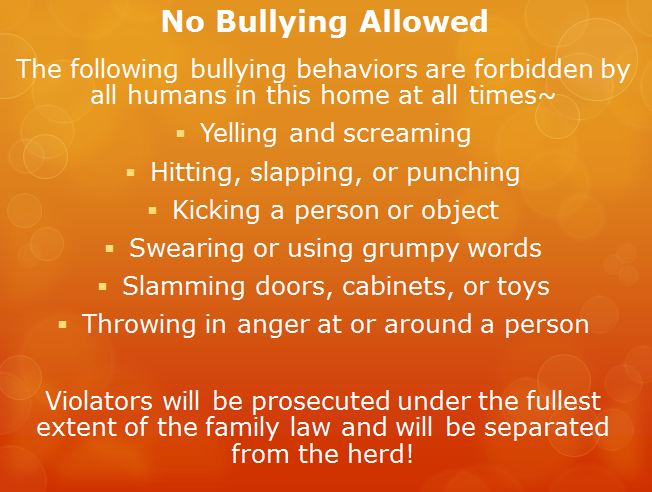
I found that these rules are useful for almost all typical social situations so once we have these established, I can feel pretty comfortable with taking them places, knowing they will abide by them. We expect our little ones to generally abide by these as young as 10-15 months old. I will explain more on how to achieve that and what we mean by “separating from the herd” in latter posts.
So there are three basic parenting situations that require addressing when it comes to rules.
1. When we go to another’s house- Have your rules about appropriate talk and behavior on our way there. I go seat by seat and specifically discuss what is expected of each one. I will take time to let them know if someone has rules different than our own, like shoes in the house, going into someone’s room, or keeping snacks in the kitchen. It may even be nice to have them in the habit of asking the hostess about those things. They should already by minding your “all-the-time” rules and whatever may be added, could be talked about before hand.
2. When friends come to your house- My best advice would be to relax as much as possible. That is different for everyone. I figure I can only modify my own children’s behavior and do my best to cope with others. I certainly will not modify my house rules to fit a guest’s desires. We basically will allow anyone to play here with a few caveats. You must shake my hand, look me in the eye, and be able to say at least 3 sentences to my face. I let them know they are welcome to play, it is nice to meet them, and there is no cussing. I also let them know that we keep our home a happy, safe place for all our children so please be sure to be nice to everyone. For those of you not yet in the “kids just show up on their bikes” phase, you will understand what this means someday. There have been instances when big kids will think it is funny to pick on a younger kid and they will get a warning or be asked to leave. It is ok to tell kids that food stays in your kitchen or drinks are only for the table. You can tell them not to touch certain toys and you can ask them to leave a room or even your home if they are not abiding to your rules. There is good in this beyond the moment. What you can say with love and respect, will later be told to them by society in less than kind ways. My main conviction is that if I can show them love and acceptance, that is my preference. I try to hold strong while letting them feel as loved and welcomed as possible. We have had more than a few stragglers come to our home who have horrid home lives. You may be the only good parent they see. If at all possible, be that person for them.
3. Going to Walmart- (or really to any public place) They need to be told in advance what you expect. They also need to know that you will not cower to a nervous bowl of mush if they misbehave in public. You are as strong and as set in your expectations as you were at home. When we first took in our one daughter from foster care, we had to do a family trip to Walmart. Well at one point she began to cry and whine, this awful noise she used to make, developed from the serious neglect she endured just before coming to our home. Well once she started doing this, my husband looked at her and said, “Oh no! No crying at Walmart. All the kids cry at Walmart. It’s just too cliché .” I burst out laughing in agreement and low and behold, tiny girl stopped crying. Sometimes just making eye contact, letting them know what is proper, and then moving on, works better than anything.
So basic rule of thumb, keep your rules consistent inside and outside of the home. Let them know when new places require additional rules. Hold others to your rules while at your home to deliver the message to your kids that your house rules are dependable, and to let other kids learn in a loving way that society is not an “anything goes.” Try and be as simple as possible so you can enjoy your time with others as well.
Blessings!
Join our conversation on Facebook https://www.facebook.com/groups/322007224621891/
Flushing the Potty Mouth

Oh yes! The moment it happens. Your child. That friend’s party. Your utter distress when your child utters those words! Your cheeks flush and you giggle that nervous giggle. “Maybe if I laugh, they’ll laugh too?” Of course most giggle too. They don’t want you to feel badly. Or they’ve been there already. But some do not giggle. Some gather their children as if they just discovered your has a plague. No plague. Just a potty mouth.
Here is where I have to give you full transparency. Moments like these can typically be traced back to my once thinking something was funny. Or worse. Something I once said. Odd how that things are funnier at home than…well…anywhere else! Then again, tone and timing are everything! My hubby and I are less than serious folk. We joke almost constantly with our children. It drew us to each other at one point but we have both been well trained in the art of when, where, and how to say a funny. Out of the mouth of babes…it can sound abysmal.
So we have found ways around this. Slowly but surely we are able to laugh more and offend less. One guide rule we set up for our preteens/teens is to think first, is this appropriate, and then is this funny. I certainly cover this over and over on our way to places where I know there will be no giggles if they get it wrong. So this is an easy technique to follow up on. If they say something inappropriate, I can simply ask, “Was it funny?,” yes, “Was it appropriate?”…blank stare.
For our littler ones we have to scale back to a far more basic bare bones technique. “If it involves your private parts (for some we just say butt), you don’t talk about it to others.” For this we have found consistency is best since they will pretty much scale up outside of the home, whatever they do and say inside the home. If someone is talking poop, pee, or anything the like, I will pull them aside and whisper, “What part of the body is that from?” They will answer the butt, and then I will say, “Do we talk about our butts to others?” They will reply a no. Now I whisper the entire conversation anytime I am covering that which you should not say. It is a way of mirroring that it really should not be said out loud, even by mama. I think it is important to mention that they can talk about those parts with mama and daddy though anytime they need to.
Everyone has different household rules. These are ours and have developed over many years as our family has grown and changed. I used to be super concerned with my child’s body image, that I would not dare set a rule about not speaking about their body. That was cool for a few years but was not a reasonable life choice for us. I do want my children to feel comfortable in their own skin and with their body parts. However, I do not want the general public to be as ok with my children’s body parts.
Whatever you chose for your household rules, try to streamline them to be consistent with your out-of-the house rules. If you are unsure about where to set the boundary line, try this; Picture your child doing or saying things at that boundary level to your husband’s great grandma Bertha, with your high school English teacher standing by, while the conversation is being recorded for playback at church. That could help you figure out what you are really comfortable with real quick!
Blessings!
This post is lovingly dedicated to all the mommies and daddies who have been horribly embarrassed by what just came out of their children’s mouths. We have all been there. You are doing a great job! Write it down, and share it at their future baby shower. They will love it!
Join our discussion on Facebook https://www.facebook.com/groups/322007224621891/
Join Our Discussion on Facebook
Mommy Bucks (Age: 4 and up)
I am a firm believer that as parents, we are charged with preparing our children for the future. With that in mind, it makes little sense to treat them in a way that is completely contrary to real life. For example, you have a sassy kid that does not want to do chores. Let’s picture how that will play out when they get their first job. If they show up sassy and unwilling to do what is expected of them…well…how long do you picture that job lasting. 5 whole minutes you say? No…even less! So why are we different as parents? Why do they do that and still get “paid?” It is not kind to still offer them unconditional currency because it instills a rather warped view of the world. One of the kindest things you will ever do for your child, is allow them to learn about the world, how to function socially and productively, amongst those who LOVE them unconditionally! Here is a great intro into currency for your children. 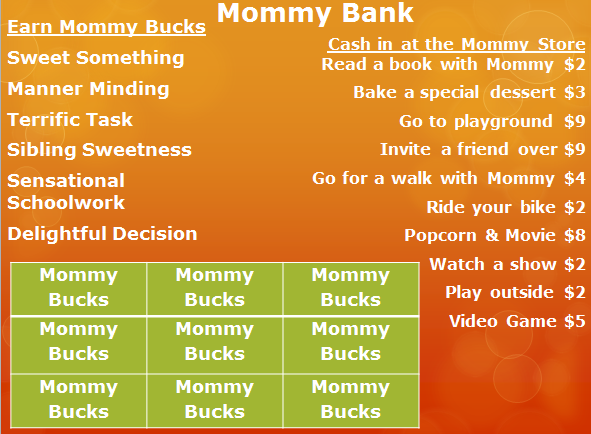
SUPPLIES:
- Print, cut out individual bucks (mommy, daddy, grandparent, etc…)
- Print out a menu of ways to earn bucks
- Print out the your menu of privileges, including what they will cost
- Frames, tape, and or tacks for hanging up your menus
- Envelopes to hide and store your bucks
- Shoebox, decorated by your child, as their “piggy bank”
This is pretty self-explanatory. Allow your child to start earning. Be gracious, seeking out opportunities to offer them bucks. Do not hand out bucks upon request. “Mom, look, I cleaned my room now give me my bucks!” We are not trying to teach them entitlement so they should be awarded bucks based on your observations, and not their requests. They may be frustrated but they will learn quickly to show you their clean room, without asking for you to give them something in return. If they are a dollar short, they cannot cash in. If it won’t work in the real world, it shouldn’t work with you. This training is great for both you AND your child. When you get in the practice of seeking out the good things they do, with praise and acclamation, it will help you to view parenting and discipline in a positive light. It will teach your child how lovely positive attention is so they will focus on what is right and good. It will instill a realistic view of what the rest of the world will expect from them.
Feel free to use this print out and to alter it as you need (Daddy Bucks, Papa Bucks, Nanny Bucks, etc…)
Join our Facebook Discussion https://www.facebook.com/groups/322007224621891/
Happy Sad Behavior Chart (age: pre-readers)
Charts can be a parent’s best friend. In fact, charts can be any caregivers best friend! Sometimes it is hard to know how to discipline those adorable chubby cheek toddlers. Here are some ideas for the pre-readers in your family so they can know what on earth you are talking about!
SUPPLIES:
- Small bulletin board
- Cut outs of a happy face and a sad face (print, cut, glue onto thin cardboard)
- Masking tape to divide the board into halves
- Cut outs of common activities (print, cut, glue onto thin cardboard)
- Thumb tacks
Here is how this works. All photos start on the “Happy” side of the board. Show your tot how awesome they are. Talk them up! Let them know you are so happy and that is why they can do all those happy things! “Oh how fun! What should we do first!?!” If they are under 4 years old, DO NOT yet present the other side until you go to use it. It is too much for them to retain just yet. When an infraction occurs such as not listening, being bold, etc…, walk them to the board and get down to their eye level, and explain what they did that was wrong. Then ask them what their favorite activity is on the board (I know…it’s cruel), and then let them know they cannot do it. You are moving it to the “Sad” side because they made you “Sad” by doing what they did. Have them help you move it. Doing = Learning = Responsibility. Ask them to apologize. Hugs, kisses, and move on! This is quick. There is no lecture. Keep the day moving. Next time you observe a positive behavior walk them to the board and get down to their eye level, and explain what they did that was right. Praise them and have them help you move the least favorite item back to the happy side, so whatever was the last one moved. Hopefully in time all the items will be on the happy side!
So why be cruel, you ask? Great question! In short, because you want to be effective. Their feelings change constantly. They may not even want to play outside so moving that piece would be ineffective. You want to give them what they need, not what they want. It is kind. Being fearful, not wanting them to cry, being overly sentimental about a minor privilege does not help either of you. As adults we work for what we want. If we do not do the work, we do not get what we want. Just as they will be unable to manipulate their bosses to paying them anyway, even if they have done an awful job, they shouldn’t learn they can manipulate you. It may make them short term happy but not long term happy. Long term happiness is grounded in security that is the fruit of firm boundaries.
Join our Facebook Discussion https://www.facebook.com/groups/322007224621891/
 Parent Blessing