Breastfeeding Trials- Just Add Pasta

pastaIf I gave you a recipe for pasta and said boil 2 cups of water, add 1 cup of pasta, a 1/4 cup of milk, some salt and some butter and you did everything but add the pasta… it would be a pretty gross lunch. Would you say, “I tried everything but it just isn’t working?”

That is similar to how it is with breastfeeding. To be successful at breastfeeding you have to add the essential ingredient…the breast! We are finding many mothers cling to advice to feed every 3 to 4 hours and that simply is not enough for the first weeks. It is a ‘good enough’ average for a well established breastfeeding relationship but it is no where near enough. Every woman has milk ducts ready to perform but it takes weeks for the “system” to mature. During those weeks many breastfeeding troubles can be avoided by simply bringing the baby to the breast as often as possible. It is not a sentence..it is practice time! The more you practice…the easier and the better the game!! We know it can be hard and we know it can hurt. We know a baby changes EVERYTHING and sometimes we are less ready for change than we think and that is ok. Just be reminded that there is a recipe for a pain-free, easy-peasy lemon squeezy breastfeeding relationship.  Commit to lots of time at the breast in the first few weeks and trust the pay off is wonderful. Take the “timed” feeding advice and put it somewhere for safekeeping. Try the “I feed my baby as often as I can” approach and then enjoy the benefits of your hard work.

There are lots of obstacles that arise when it comes to breastfeeding. Please do not throw in the towel any sooner than you would like to. Please reach out for help if you would like it.

And what ever you do…if you are to make pasta…add the pasta!!

Lots of love and hope for new breastfeeding moms!

When are you going to stop Breastfeeding?

breastssI don’t know about you but the one question I get more than any other is, “when are you going to stop breastfeeding?” It comes harshly, softly, or with a scoff. It comes from doctors, family, friends, and perfect strangers. I have learned to say, “when he is done” and try to turn the conversation to something appropriate. The truth is I love to breastfeed. Not for any odd reason but because it makes life with my son so much better. I followed the “timeline” approach with the first two boys because I never knew there was another option. With our last boy I was introduced to extended nursing (usually means beyond the first year) and what a miracle it has been. I wish I had known for the first two but no regrets. I enjoyed, and continue to enjoy those two, daily. I have learned that breastmilk does not shut off the nutrition on his 1 year birthday. We quite effortlessly nursed through  H1N1, cold and flu season, strep outbreak, etc… without getting sick. I love the “no extra co-pays” strategy of saving money. I have never been a pillar of health and I think so often how I am helping my little guy avoid a lifetime of poor health. Cancer runs deep in my family and I think often about what I am doing daily to lower my breast cancer rate and how I am lowering both childhood cancers and prostrate cancer for him later in life. I have a hole in my heart and have seen on the news the rate of heart disease skyrocketing and yet I am lowering my rate daily.  My top enjoyment is the bonding though. I have a little boy who so completely trusts and loves me that his independence flows! I can have confidence that if I leave him to go out he will be completely secure and happy. I never worry my babysitter will tell me he was difficult to manage. I know too that I am helping to make school a little easier for him each month as his IQ gets a supercharged boost. The bottom line is, breastmilk is good the infant and good for the toddler. Breastfeeding is personal; the how long and the why behind your breastfeeding relationship is between mother and child and we should honor and encourage it. It is often hurtful when I am put down for it but the confidence I have in knowing it is a gift I am giving to both of us far outweighs any bad feelings. My little guy will be 2 next month…when will I stop breastfeeding him you ask? When he is done!

I wrote this about 4 years back when I was hearing so much kickback and pressure from others towards me and towards friends of mine. The idea is to breastfeed as long is as mutually beneficial to mother and baby.

3-12 months Gentle Guidance

 brestEntering this next phase you are feeling a bit exhausted. During this phase you will be shaping some new structure into your day. You may be getting more creative now that nursing has been established. Maybe after the last nursing of the night/early morning, your partner puts on the wrap and allows you 2 hours of uninterrupted sleep. You have researched weaning and have decided that delaying solids until closer to the end of the year is best for his digestive system. Everyday you are making good choices while being sensitive to your baby’s needs. When he cries you hold him, nurse him, and meet his needs. You spend time reading with him, exercising his tiny little muscles, and teaching him about his world. You are instilling selflessness, self-control, patience, and kindness. You have been consistent and you never allow discourse to be in his presence. Anytime you have felt frustrated, you have sought out help from other moms while maintaining a calm demeanor with him. You child-proofed your house so he won’t get into trouble and you have begun to tell him no when he reaches for something dangerous. You talk to him when he nurses so he gets used to listening to your voice. You teach him his “nice words” like “gentle, sweet, kind, etc…” You teach him important words like “No touch, no bite,” and other small corrections. You can take his hand while he is nursing and stroke your face calmly and sweetly saying “nice or kind or gentle.” He is learning everyday so make the most of it. His understanding of these words will come in handy during the next phase!

0-3 Months- Discipline begins at the breast!!

babWay to go mommy! You did it! You carried this amazing baby for 40 weeks (give or take). You may have been sick, you were uncomfortable, you watched your little jeans fade into the distance as they were replaced with cotton stretchy pants. You took those awful prenatal vitamins and you ate right, sometimes 10 times a day. You read books and you were given advice by hundreds of “helpful experts.” Now here you are…officially on to the next stage. You are now thinking about personality and wondering…how hard is this going to be? How is my life going to change? At this point you may automatically relate the word “discipline” to words like “time-out” or “grounding” or “spanking.” Discipline may seem like a tool for the future but it is not. It is now. It arrived at birth and begins at the breast. The very frist step is guiding your baby to latch properly. If it hurts, you break the latch and try again. You are teaching your baby what is right and what is wrong. You are doing this because you know what is best. You are unafraid, confident, patient, and best of all, consistant. You may work at this over and over but it is the right thing to do. You will also be waking him up so he can nurse every 1 to 2 hours. You know this is what is best for him and for you. He may be sleepy but you are a wise mommy and you are guiding him to bring your milk in and thrive. You will also be teaching your baby how to be content. You know “self soothing” is wrong and that babies are meant to be soothed by mommy and guided towards contentment and independence. He can’t walk or talk and you are learning to be a mommy. You start by responding to all of his cues to nurse. You keep your baby close to you night and day so that each time his eyes flutter, fingers twitch or he starts to fuss, he will be nursed right away. You are teaching him that he does not need to wail and cry to have his needs met and setting up the framework for less tantrums in the future. You have not allowed pacifiers or bottles. No! You want happiness and contentment for him and no substitute will work long term. You nurse on demand and wear him and pour love all over him. He is snuggled and nursed and soothed and this is beginning to shape his character into a lovely, happy, peaceful child.

Her Rules, My Rules, This Cruddy Playdate

I will gladly admit to being the more laid back parent at the play date and will offer that is has bugged a few people. Then, as that same women, I will at times be the most strict at the play date. It depends on who is there. I am not big on having lots of rules. I like a few general principals and will tweak as I see need. This is a difficult post since each family is so different. I cannot and will not tell you how to set your rules. I will encourage you, as I share mine, to read between the lines to find what suits your family best.

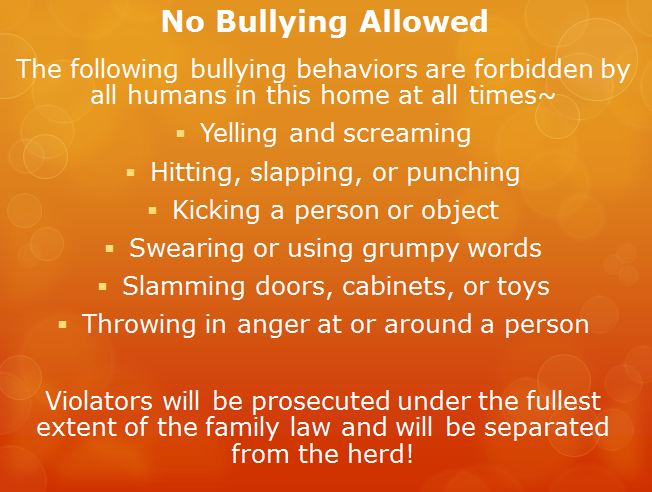
In place of a lengthy list of rules, we do wider based principles. Our major, untouchable, immovable family rule, is “No Bullying!” This was set up way before bullying became such an epidemic in our schools and since it is our most important family principle, we have kept the line the same. Bullying, in our family, incorporates a gambit of critical no’s. Here is a sign I have had made for this. Keep in mind our family adopts and fosters so we carry rules that will allow persons from abusive backgrounds to feel comfortable. No Bullying

I found that these rules are useful for almost all typical social situations so once we have these established, I can feel pretty comfortable with taking them places, knowing they will abide by them. We expect our little ones to generally abide by these as young as 10-15 months old. I will explain more on how to achieve that and what we mean by “separating from the herd” in latter posts.

So there are three basic parenting situations that require addressing when it comes to rules.

1. When we go to another’s house- Have your rules about appropriate talk and behavior on our way there. I go seat by seat and specifically discuss what is expected of each one. I will take time to let them know if someone has rules different than our own, like shoes in the house, going into someone’s room, or keeping snacks in the kitchen. It may even be nice to have them in the habit of asking the hostess about those things. They should already by minding your “all-the-time” rules and whatever may be added, could be talked about before hand.

2. When friends come to your house- My best advice would be to relax as much as possible. That is different for everyone. I figure I can only modify my own children’s behavior and do my best to cope with others. I certainly will not modify my house rules to fit a guest’s desires. We basically will allow anyone to play here with a few caveats. You must shake my hand, look me in the eye, and be able to say at least 3 sentences to my face. I let them know they are welcome to play, it is nice to meet them, and there is no cussing. I also let them know that we keep our home a happy, safe place for all our children so please be sure to be nice to everyone. For those of you not yet in the “kids just show up on their bikes” phase, you will understand what this means someday. There have been instances when big kids will think it is funny to pick on a younger kid and they will get a warning or be asked to leave. It is ok to tell kids that food stays in your kitchen or drinks are only for the table. You can tell them not to touch certain toys and you can ask them to leave a room or even your home if they are not abiding to your rules. There is good in this beyond the moment. What you can say with love and respect, will later be told to them by society in less than kind ways. My main conviction is that if I can show them love and acceptance, that is my preference. I try to hold strong while letting them feel as loved and welcomed as possible. We have had more than a few stragglers come to our home who have horrid home lives. You may be the only good parent they see. If at all possible, be that person for them.

3. Going to Walmart- (or really to any public place) They need to be told in advance what you expect. They also need to know that you will not cower to a nervous bowl of mush if they misbehave in public. You are as strong and as set in your expectations as you were at home. When we first took in our one daughter from foster care, we had to do a family trip to Walmart. Well at one point she began to cry and whine, this awful noise she used to make, developed from the serious neglect she endured just before coming to our home. Well once she started doing this, my husband looked at her and said, “Oh no! No crying at Walmart. All the kids cry at Walmart. It’s just too cliché .” I burst out laughing in agreement and low and behold, tiny girl stopped crying. Sometimes just making eye contact, letting them know what is proper, and then moving on, works better than anything.

So basic rule of thumb, keep your rules consistent inside and outside of the home. Let them know when new places require additional rules. Hold others to your rules while at your home to deliver the message to your kids that your house rules are dependable, and to let other kids learn in a loving way that society is not an “anything goes.”  Try and be as simple as possible so you can enjoy your time with others as well.

Blessings!

Join our conversation on Facebook https://www.facebook.com/groups/322007224621891/

Flushing the Potty Mouth

potty mouth

Oh yes! The moment it happens. Your child. That friend’s party. Your utter distress when your child utters those words! Your cheeks flush and you giggle that nervous giggle. “Maybe if I laugh, they’ll laugh too?” Of course most giggle too. They don’t want you to feel badly. Or they’ve been there already. But some do not giggle. Some gather their children as if they just discovered your has a plague. No plague. Just a potty mouth.

Here is where I have to give you full transparency. Moments like these can typically be traced back to my once thinking something was funny. Or worse. Something I once said. Odd how that things are funnier at home than…well…anywhere else! Then again, tone and timing are everything! My hubby and I are less than serious folk. We joke almost constantly with our children. It drew us to each other at one point but we have both been well trained in the art of when, where, and how to say a funny. Out of the mouth of babes…it can sound abysmal.

So we have found ways around this. Slowly but surely we are able to laugh more and offend less. One guide rule we set up for our preteens/teens is to think first, is this appropriate, and then is this funny. I certainly cover this over and over on our way to places where I know there will be no giggles if they get it wrong. So this is an easy technique to follow up on. If they say something inappropriate, I can simply ask, “Was it funny?,” yes, “Was it appropriate?”…blank stare.

For our littler ones we have to scale back to a far more basic bare bones technique. “If it involves your private parts (for some we just say butt), you don’t talk about it to others.” For this we have found consistency is best since they will pretty much scale up outside of the home, whatever they do and say inside the home. If someone is talking poop, pee, or anything the like, I will pull them aside and whisper,What part of the body is that from?” They will answer the butt, and then I will say, “Do we talk about our butts to others?” They will reply a no. Now I whisper the entire conversation anytime I am covering that which you should not say. It is a way of mirroring that it really should not be said out loud, even by mama. I think it is important to mention that they can talk about those parts with mama and daddy though anytime they need to.

Everyone has different household rules. These are ours and have developed over many years as our family has grown and changed. I used to be super concerned with my child’s body image, that I would not dare set a rule about not speaking about their body. That was cool for a few years but was not a reasonable life choice for us. I do want my children to feel comfortable in their own skin and with their body parts. However, I do not want the general public to be as ok with my children’s body parts.

Whatever you chose for your household rules, try to streamline them to be consistent with your out-of-the house rules. If you are unsure about where to set the boundary line, try this; Picture your child doing or saying things at that boundary level to your husband’s great grandma Bertha, with your high school English teacher standing by, while the conversation is being recorded for playback at church. That could help you figure out what you are really comfortable with real quick!

Blessings!

This post is lovingly dedicated to all the mommies and daddies who have been horribly embarrassed by what just came out of their children’s mouths. We have all been there. You are doing a great job! Write it down, and share it at their future baby shower. They will love it!

Join our discussion on Facebook https://www.facebook.com/groups/322007224621891/

Your Child is Afraid

PEACE_Romans5_1700_1163Fear is an unavoidable obstacle in each child’s life. Fear is often the source of poor behavior. If we can help our children cope with fear, we will have listening ears and willing hearts! So why do our children get scared? Lots of reasons! This world looks and feels insane to our little ones and even our big ones. Do you ever take a moment to consider what your child may be afraid of? Really. Think for a minute. Have you ever asked your child what they are scared of? Many parents would be surprised to hear those little responses! Simply telling a child not to worry won’t cut it anymore than that would work for you when you are overcome with fear. Here is a little exercise for you…

  1. Take a minute for yourself and write down some of things you are currently afraid of. Ask yourself what you are worried about. Do some digging. Allow yourself to reflect on what that feels like to you and then compare how your child might be feeling that same feeling.
  2. Sit down with your child and ask them, “Can you tell me everything you are afraid of?” Really take your time with this. Be empathetic. Refuse the instinct to talk them out of it. Just empathize no matter how ridiculous it may seem. “Wow. I would feel afraid too if I thought someone may come in my window at night,” or “I can see why you would feel so overwhelmed and scared about all the work you need to do at school!” Just let them go on and on and on and on and…well you get the picture. Your job here is to empathize and validate, empathize and validate, empathize and validate.
  3. Now ask your child, “What can I do to help you when you feel afraid?” Offer ideas if they are unsure. There are lots of them!
  • Do a room walk through before bed to check windows and doors, physically showing your child how secure they are.
  • Fill a spray bottle with water and spray the fears away. Some call this monster spray. You can add a dash of room freshener or body spray to give it a light scent. Remember it will be used fairly liberally so a little dab will do you scent-wise!
  • Pray with your child, specifically asking God to help him not be afraid of “name fear.” The ancient Scriptures tell us that “God gave us a spirit not of fear but of power and love and self-control.” You can find that verse in 2 Timothy 1:7. Wouldn’t your child love to feel powerful?!?
  • Offer your child a vacation from their fears! Get them out and doing things that help them get their minds off of what is consuming them. Please do not try this at home!
  • Tell your child how to come to you next time they are scared. You may want to be creative here and create a technique just for you and your child. One technique may be to have them draw you a picture and bring it to you to talk about. Another could be a homemade necklace, hung on the wall, that your child could put on to show you they need to talk.
  • Tell your child you do when you are afraid. Children think we are fearless, but that is more of a goal than a reality, wouldn’t you agree?
  • Address the “big guns” head on! Children who have gone through trauma will carry a huge burden on their shoulders. They need you to use real words to describe why they are hurting and what they have gone through. If you do not offer this, they will grow up thinking they are crazy. As hard as some of the trauma may be to talk about it, they have to talk about it, and they need you to use real words to describe what they have been through. “Yes, honey, before you came to our home, you did not eat very often. I will make sure you always have food so you never have to worry,” or “I know “people” used to hurt your body. It is not ok to hurt you. In our family, we will never hurt each other’s bodies.” (We will speak more on this topic at a later time.)

Join our Facebook Discussion https://www.facebook.com/groups/322007224621891/


Facing Fear

boilingFear is a very real, and very difficult realty for children. Many times, unpleasant behaviors stem from fear. If you can help your child manage their fears, you can manage behavior. Fears can be real or imagined. A child who had early trauma such as abuse, family change, moving, or a host of other issues, may find fear surfacing over and over again. A new member may enter a family and may stir up fear in the children who were there first. Parents may suffer a loss or transition, that causes their children to worry. Peers can be a source of fear. School, sports, and other activities may be enjoyable for a child but enjoyment does not always mean they are not hiding a seed of fear.

Here are some simple ways you can combat fear in your home. Many of them will work on your fears too!

COMBAT FEAR

  • Remove the child from the situation. “A vacation from my problems!”

Vacation Day Ideas

  • Create a way to talk about fears
  • Ask how you can help
  • Offer rest
  • Help find positive outlets
  • Find purposeful “love moments”
  • Empathize! …but don’t sabotage
  • Create routine and structure
  • Be sure everyone knows their role in the family
  • Try a family meeting

Join our Facebook Discussion https://www.facebook.com/groups/322007224621891/

Mommy Bucks (Age: 4 and up)

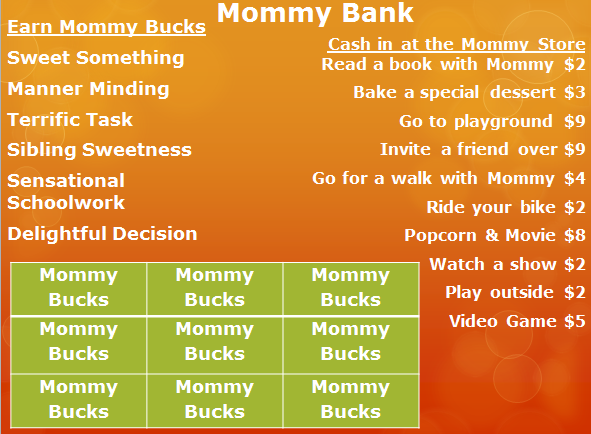
I am a firm believer that as parents, we are charged with preparing our children for the future. With that in mind, it makes little sense to treat them in a way that is completely contrary to real life. For example, you have a sassy kid that does not want to do chores. Let’s picture how that will play out when they get their first job. If they show up sassy and unwilling to do what is expected of them…well…how long do you picture that job lasting. 5 whole minutes you say? No…even less! So why are we different as parents? Why do they do that and still get “paid?” It is not kind to still offer them unconditional currency because it instills a rather warped view of the world. One of the kindest things you will ever do for your child, is allow them to learn about the world, how to function socially and productively, amongst those who LOVE them unconditionally! Here is a great intro into currency for your children. Mommybank

SUPPLIES:

  • Print, cut out individual bucks (mommy, daddy, grandparent, etc…)
  • Print out a menu of ways to earn bucks
  • Print out the your menu of privileges, including what they will cost
  • Frames, tape, and or tacks for hanging up your menus
  • Envelopes to hide and store your bucks
  • Shoebox, decorated by your child, as their “piggy bank”

This is pretty self-explanatory. Allow your child to start earning. Be gracious, seeking out opportunities to offer them bucks. Do not hand out bucks upon request. “Mom, look, I cleaned my room now give me my bucks!” We are not trying to teach them entitlement so they should be awarded bucks based on your observations, and not their requests. They may be frustrated but they will learn quickly to show you their clean room, without asking for you to give them something in return. If they are a dollar short, they cannot cash in. If it won’t work in the real world, it shouldn’t work with you. This training is great for both you AND your child. When you get in the practice of seeking out the good things they do, with praise and acclamation, it will help you to view parenting and discipline in a positive light. It will teach your child how lovely positive attention is so they will focus on what is right and good. It will instill a realistic view of what the rest of the world will expect from them.

Feel free to use this print out and to alter it as you need (Daddy Bucks, Papa Bucks, Nanny Bucks, etc…)

MOMMY BANK

Join our Facebook Discussion https://www.facebook.com/groups/322007224621891/